The compressing effect of history tends to reduce British monarchs to a few words and deeds. Henry VIII, who reigned from 1509 to 1547, went through wives like handkerchiefs, in the process breaking with Rome and sparking the English Reformation. His daughter, Elizabeth I (1558–1603), enthralled her subjects and presided over a golden age of stability.
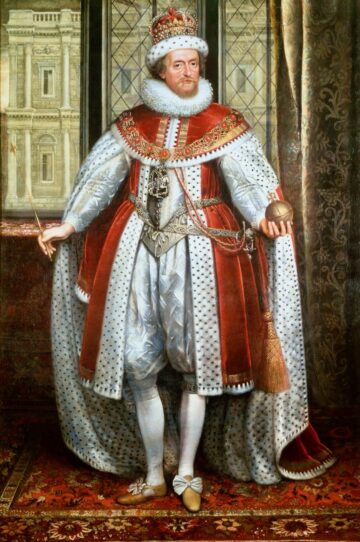
Where does that leave James I, who ruled England from 1603 to 1625 after first reigning as James VI of Scotland? Lord Macaulay, the author of The History of England (1848), described James as “stammering, slobbering, shedding unmanly tears, trembling at a drawn sword, and talking in the style alternately of a buffoon and a pedagogue.” J.P. Kenyon’s 1958 history of the Stuart dynasty, which began with James and lasted 111 years, cited James’s “vulgarity, obscenity and uproarious pedantry.” These harsh assessments are almost cartoonish in their distaste.
“Four centuries is too long for anyone to remain in rehab,” writes Clare Jackson in The Mirror of Great Britain. Her book is the widest-ranging entry among a handful of titles that commemorate the 400th anniversary of James’s death and urge a general reappraisal of his reign. Ms. Jackson is no apologist—her James has flaws aplenty—but where prior historians offered snide caricature, she portrays a complex leader who was “intelligent, resilient, idiosyncratic, irascible, guileful and witty.”
James lived during times of Continental war and religious strife. He became king of Scotland in the cradle, following the abdication of his mother, Mary, Queen of Scots. (Mary was kept under house arrest in England for nearly 20 years by her cousin, Elizabeth I of England, and eventually executed.) James ruled Scotland as king first under a series of regent and then, for two decades, in his own right. He assumed the English crown as well in 1603, when Elizabeth died with no immediate heir. In both his realms, James worked to solidify the Reformation while facing attacks from the Puritans as an oppressor and from Rome as a heretic. A perennial target of assassins, James survived the Gunpowder Plot of 1605, when Guy Fawkes and confederates hoped to blow up Parliament.
Ms. Jackson presents the Jacobean era as an inflection point for the British Isles, encompassing a series of firsts as well as lasts. James’s accession to the Scottish throne was the first Protestant coronation in Scotland’s history. He was the first leader to preside over what he began to call “Great” Britain or to hoist a “Union” Jack. The last man to be executed for heresy in England was burned at the stake on James’s order. In like vein, James was the last British monarch to step into the role of judge and pass sentence on one of his subjects.
J.P. Kenyon’s dig at “uproarious pedantry” nods to James’s intellectual pretensions, which some courtiers derided—even though a learned monarch seems preferable to an ignorant one. James was a prolific poet and author, defending Protestantism in his Premonition to all Christian Monarchies (1609) and writing a treatise on kingship, Basilikon Doron(1599). Perhaps most significantly, by commissioning the drafting of the King James Bible, he made one of the great contributions to the development of the English language.
The king’s foreign policy had a mixed record, according to Anna Whitelock in The Sun Rising. His attempt to formally unite England and Scotland failed in Parliament in 1607, and his plan to anglicize Ireland by “planting” Ulster with English and Scottish settlers would lead to generations of internecine violence. James jockeyed with Spain in the New World, which gave England a foothold in the North American colonies, but the settlers were poorly supported and left to fight deadly squabbles with the Native Americans.
Above all, Ms. Whitelock, a professor of history at the University of London, writes about James’s pursuit of peace. Styling himself rex pacificus, he concluded England’s war with Spain in 1604 and tried to avoid being drawn into other conflicts, sometimes by engineering fragile compromises. The result was peace during his time but strife soon afterward. His successor, Charles I, ultimately couldn’t avoid the Thirty Years’ War on the Continent; his squabbling with Parliament helped lead to the rebellion and civil war that engulfed Ireland, Wales, Scotland and England. Ms. Whitelock persuasively concludes that James was more “a supporting character” than a driver of global events.
The sneering attitude so many historians once displayed toward James seems to owe not a little to his policy of avoiding war at all costs, as well as to his bisexuality. James was perennially in love, writes the historian Gareth Russell in The Six Loves of James I. He had a long and affectionate marriage to Queen Anna and fathered multiple children. The evidence suggests that James also had liaisons with several of the queen’s ladies-in-waiting. Yet he gave his heart to a series of men, from flings (Lord Philip Herbert was “handsome as Adonis and as stupid as a tree stump,” Mr. Russell writes) to enduring affairs.
The two loves of James’s life, Mr. Russell contends, were Robert Carr and George Villiers. In 1614, after Carr’s seven years in favor, Villiers supplanted him in the king’s affections. James had a special passage created linking his bedroom to Villiers’s, and the king addressed his lover in letters as “my only sweet wife”; Villiers called James “my dear husband.” Their correspondence is enough to make a reader blush. James’s open displays of affection—kisses, tears—with men at court prompted detractors in Parliament to denounce his foreign policy as “effeminate.”
Such dismissiveness doesn’t stand up to modern scrutiny. Avoiding war was a good policy in an age when many monarchs, including Charles I, would risk their positions through expensive adventures; in any case it has little to do with sexual orientation. Mr. Russell helps readers contextualize James’s reputation, which has been pickled in generations of macho nonsense. Yet in doing so, the author does reveal a weakness of James as a monarch.
It wasn’t his sexuality, the author suggests, but his heart, and particularly the way it consumed and distracted him. James lavished honors and titles on Carr and Villiers, both ambitious men, turning the court into a den of patronage-for-love. Mr. Russell concludes that the king “became too dependent on his favorites,” substituting their whims for expert advice. It was good while it lasted, but the peace of James’s reign soon ended. After his death in 1625, England experienced civil war, the execution of Charles I and the brutalities of Oliver Cromwell’s rule. James wasn’t the buffoon his critics disdain, but nor was he a durable leader whose reforms would endure.