Meet Lou Junod (1919–2006). A leather goods salesman from Brooklyn, he worshipped the sun and loved nothing better than a “fresh burn.” He carried a solid gold money clip shaped like an Oscar statuette. After a grenade almost killed him in Normandy, he earned a Purple Heart and then sang in the jazz clubs of Paris. He liked to wear a red velvet smoking jacket, paired with a bow tie. He once ran into Cary Grant at a showroom in New York; the two panthers acknowledged each other on a first-name basis, as equals. An elaborately scented man, Lou stocked his bathroom with rows of tonics and lotions, lined up like assassin’s knives. He was on intimate terms with not one but two Gabor sisters, Eva and Zsa Zsa. As he told his son, referring not to those particular ladies but to women generally, pausing for emphasis, “they can’t keep their eyes off…your father.”
The son in question is Tom Junod, the award-winning magazine reporter who spent time at Esquire and Sports Illustrated and now writes for ESPN. Mr. Junod’s memoir, In the Days of My Youth I Was Told What It Means To Be a Man, offers one of the great bravura displays of sustained artistic tribute toward a complex paterfamilias in recent memory. The last written example this entertaining was the chapter in John Le Carré’s 2016 memoir The Pigeon Tunnel, about that author’s crook of an old man, Ronnie Cromwell. Royal Tenenbaum also springs to mind (“I used to be a homeowner myself, until our son expropriated it from me”), from Wes Anderson’s 2001 film.
Lou is the center of this exceptional book, yet he would not have raised it from good to outstanding were he merely a character. The question Mr. Junod explores is whether his father was also a scoundrel or instead merely a rascal. In other words: was he forgivable or not? “He was a scrupulously superficial man, believing so fervently in the magic of surfaces that his fervor almost passed for profundity,” Mr. Junod writes. He lived like a celebrity, “yet he makes his living selling handbags.”
In the 1960s, Mr. Junod and his mother were happiest when Lou was away on trips in places like Miami and Las Vegas, where he went to sell product and “get some sun.” The author lived in awe of his father, at once afraid of him and in thrall to his boundless charisma and movie-star looks. An energetic philanderer, Lou humiliated his wife, Fran, carrying on affairs right in front of her. One of his mistresses gave a spirited eulogy at his funeral. He threw all his money away on bad investments and ended up broke. When Mr. Junod found compassion and understanding while profiling Fred Rogers for a magazine story—yielding a movie starring Tom Hanks, A Beautiful Day in the Neighborhood—Lou, perhaps feeling upstaged, merely dismissed Mr. Rogers as effeminate.
Yet Lou could also be tender. He liked to greet his boy from behind the basement bar by asking, “What’ll you have?” prompting the son to respond, “a double,” before receiving his ginger ale. They raised glasses and said salute before drinking. Years later, Lou shook with tears and reached for his son’s hand in his own mother’s hospital room as she lay stricken with illness. Lou Junod is as complicated as a character in a Saul Bellow novel, a surging metropolis of outrageous contradiction and pathos. The author captures him with nuance, humor and tremendous verve. At age sixty-five, Lou served as his son’s best man. The reader settles in for a major set piece, but he proved too nervous to sing or give a decent toast. “It’s one of the first times I’ve seen him fail,” Mr. Junod writes, “and yet it makes me love him all the more.”
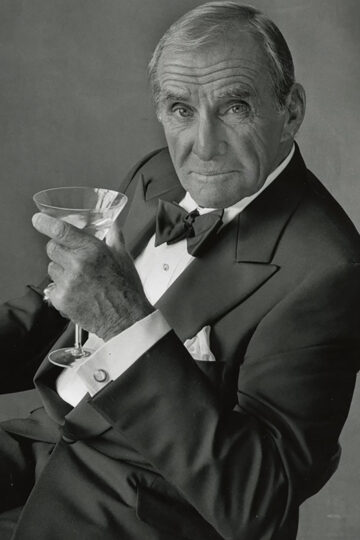
The book builds on a feature that Mr. Junod wrote in 2007 for GQ about his father’s fashion tips and lifestyle rules. The accompanying photo of a tuxedoed Lou holding a martini and staring into the camera is extraordinary: he is Hollywood handsome, the pinnacle of manhood, virile and bold even in the September of his years. But the enterprise was a kind of sham. Mr. Junod reveals that by that point, at age 77, Lou had abandoned his own maxims about turtlenecks (the most flattering garment a man can wear) and witch hazel (for cleaning the navel), dressing shabbily and throwing his money away. “I am writing it to show him that I am finally successful,” Mr. Junod writes,” and to make him understand I owe much of my success to him.” Yet Mr. Junod confesses to the reader that he desperately does not want to be like his father.
As a reading experience, In the Days of My Youth is a little like watching Goodfellas or Boogie Nights. The first half feels amazing; the second half is a huge bill coming due. After his father’s death, Mr. Junod goes on a sort of genealogical quest, excavating not only Lou’s double and triple lives—mistresses, deceptions, suspicious deaths, briefcases full of ugly secrets—but also more distant family history. Lou’s story more than holds the reader’s interest, particularly with respect to a new family member Mr. Junod discovers and embraces. Yet the weakest section of the memoir pertains to Mr. Junod’s grandmother—Lou’s mother—and her various misdeeds, including her peripheral involvement in a 1935 crime. This is already a long book, and it would have been better without the ancillary stories.
Ultimately, In the Days of My Youth confronts readers with a perplexing question: can someone be a good father but a bad man? Lou adored his son, showering him with attention and affection. Yet parenthood is about more than love; it is also about setting an example. Lou seemed to enjoy his son best when he acted out the old man’s hidebound conception of masculinity—like the time Lou goaded Mr. Junod to betray his wife by picking up a woman in a bar. Lou wanted to look at his son and see his own brilliant reflection. Not exactly father of the year. But what a view.