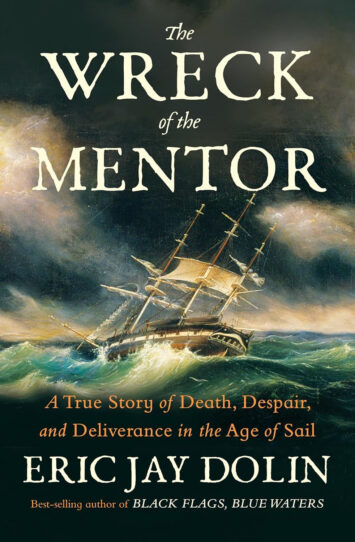
In November 1832, eight survivors of the sunken American whaleship Mentor set out into the Pacific Ocean in a pair of rickety boats. The party aimed for Ternate, an island in Indonesia, 800 miles from their shipwreck. A series of calamities followed. First a boat’s rudder snapped. Then came drenching storms, followed by the maddening doldrums. A mast cracked, and the group lost most of its provisions overboard. The men warded off thirst by sucking on buttons and kept warm by dipping their clothes into the bath-like sea. After fourteen desperate days, the wayfarers surrendered to indigenous members of the tiny island of Tobi, who claimed them as slaves.
The mariners’ story—headline news at the time but largely forgotten since—is resuscitated in Eric Jay Dolin’s The Wreck of the Mentor. Mr. Dolin is an experienced hand at nautical adventure; this is his seventeenth book. In addition to recounting an exciting and at times almost unbelievably dramatic story, the author helps readers appreciate how Western visitors affected the delicate balance of power among indigenous cultures—sometimes forcefully, but often unwittingly.
The Mentor had set sail from New Bedford, Massachusetts, the whaling capital of the United States, in July 1831, with a complement of 21 men led by Capt. Edward Barnard. Like Herman Melville’s Pequod, the Mentor sought the sperm whale and its barrels of valuable oil. Before the ship ran into trouble, it traveled halfway around the world—across the Atlantic to the Azores, then down the western coast of Africa, rounding the Cape of Good Hope and passing Madagascar on its way across the Indian Ocean toward Timor. After taking on water and supplies, the Mentor set a course for Guam in the Pacific. It never arrived.
After nearly a year of sailing, the ship struck a reef in heavy storms and foundered on May 21, 1832. The crew found itself off the coast of Palau, an archipelago of some 340 small islands in the Pacific with a total land area of 189 square miles. Ten men set off in a quarter boat and were never heard from again. Another man drowned. The remaining eleven, including Barnard, rowed for land three miles distant. They loaded their whaleboat with “a keg of water, a small chest of hardtack, clothes, an empty canister of gunpowder, one musket, a pair of pistols, a quadrant compass, a sextant, three cutlasses, and a tinder box.”
There followed a complex series of interactions with three different Palauan nations. Mr. Dolin concedes that his source material for the tale is necessarily one-sided; the Palauans did not leave written records of their encounters with the Mentor’s crew. After an initial, glancing chase by a group of indigenous men bent on seizing the whalemen’s clothing and weapons, the survivors landed on the Palauan island of Babeldaob. There they were taken in by the natives of the village of Ngarchelong, relying on them for food and shelter.
The Ngarchelongese were initially hostile because they thought the whalers were English. British mariners shipwrecked on Palau some 50 years earlier had helped another confederation, the Koror people, in war with a feuding village. English firepower proved decisive, tipping Palau’s balance of power toward the Koror for generations. Once it became clear that the Mentors were American, the Ngarchelongese agreed to help them get home by building them a canoe to supplement their whaling boat. In exchange, they demanded that the whalers return with 200 muskets. Three Americans would stay behind, while three Ngarchelongese would make the journey as a guarantee.
The rival Kororese learned of the deal and realized the effect that the rifles would have on their own regional advantage; they threatened war. But the Americans nevertheless departed—the two rickety boats—only to end up in the hands of a third group, the Tobians. These people were less advanced than the other Palauans, living on coconuts and fish on a tiny island a mile long. One American, Horace Holden, who later wrote a book about his experiences, called them “cowardly and servile, yet most barbarous and cruel.” Mr. Dolin protests that the Tobians “had their own vibrant community life, replete with customs, practices, beliefs, and hierarchies.” Yet they proved fearsome captors, armed with long spears tipped with shark teeth.
Here the ethics of survival come into play. As they suffered beatings and slowly starved, the Mentors looked for any opportunity to escape. Barnard and another man got their chance in February 1833, after several months in captivity, finding their way onto a passing Spanish ship. Barnard later faced harsh scrutiny for leaving his men behind. He lobbied the Navy to send a mission for the men who remained on Tobi, who were forcibly tattooed, made to work naked, and kept in a malnourished state. All but three died over the ensuing year—killed in punishment or lost to starvation—leaving only Holden, one other American and one surviving Ngarchelong chief. Their eventual escape in 1834, after two years on Tobi, is so suspenseful that it should not be spoiled.
Many books about Western encounters with indigenous people in the 18th and 19th centuries are necessarily one-sided affairs haunted by genocide, disease and cruel warfare. The Wreck of the Mentor makes for less-guilty adventure reading, depicting a scenario where the odds were leveled by circumstance. Stranded on foreign soil and deprived of weapons, the whalers became pawns in a standoff between nations whose dynamics and language they did not understand. Diplomacy and wit proved as important as force.