When I began commuting by train to Chicago two decades ago, nearly all my fellow passengers read the newspaper. I watched them turn the pages of The Wall Street Journal, The New York Times, and especially the Chicago Tribune as the train moved from the suburbs into the city. Over the years, their habits changed alongside the fortunes of the hometown rag. The Tribune Company filed for bankruptcy in 2008 and was later acquired by a hedge fund; today, the Tribune is a shell of what it once was, thin both in heft and in coverage. I don’t see commuters reading it or any other paper on the train anymore. These days, apart from the go-getters buried in laptops, passengers scroll their phones. Occasionally I spot a fellow bibliophile.
Now that the debate over the “reading crisis” has reached its backlash stage, anecdotes like this one have become the stuff of suspicion and critique. Rather than bolstering the case that literacy is atrophying, they trigger points of order for being received wisdom with little probative value. Statistics that seem to establish the decline of reading are likewise met with skepticism. A much-discussed essay by Rose Horowitch in The Atlantic this summer cited figures from the National Endowment for the Arts and the Bureau of Labor Statistics showing that reading is on the wane across many demographics in the United States. In The New York Times, David Wallace-Wells parsed the data and reached a less dire (yet still not very hopeful) conclusion. Then there are scholars of literacy and education, who denounce what they see as the reduction of their complex field to layman’s terms.
Most commenters agree that reading is in trouble; the question is just how bad things have gotten. One worrying figure shows that the reading ability of American high school seniors—35 percent proficiency—is lower than at any level since the National Assessment of Educational Progress began measuring it in 1992. Another troubling study, from the Organization for Economic Co-operation and Development, which looks beyond the United States to examine 31 Western countries, found that literacy is stagnating or declining in all but two (Denmark and Finland). Notably, the OECD data show that some countries enjoy improving reading rates among their most educated citizens but dipping rates among the least educated, revealing a growing literacy inequality. One of the most thorough collections of statistics and analysis in recent decades comes from writer Caleb Crain, who examined the reading crisis for The New Yorker in 2007. He drew attention to a long-running NEA survey showing a gradual decline in the percentage of Americans who had read a work of creative literature in the past year; its 2022 edition revealed that the number had dropped from 56.9 percent in 1982 to 37.6 percent that year.
Amid these particulars, I can’t help but think that my experience on Chicago’s trains serves as a decent finger-in-the-air barometer—much as emptying movie theaters reflect the broad struggles of Hollywood. My fellow passengers’ habits may establish nothing more than the erosion of the newspaper industry—although in a market economy, supply often follows demand. Or they could merely indicate the evolution in consumer habits from print toward online news. But I don’t see commuters thoughtfully reading articles on their phones. Their thumbs are busy with that restless upward swipe we all know so well: the perennially dissatisfied, semiconscious search for the next piece of content. The daily routine that a commute once provided to learn something or better oneself—even, to be idealistic, to serve as an active participant in a democracy—has been replaced with the bored equivalent of channel surfing or eating a bag of chips.
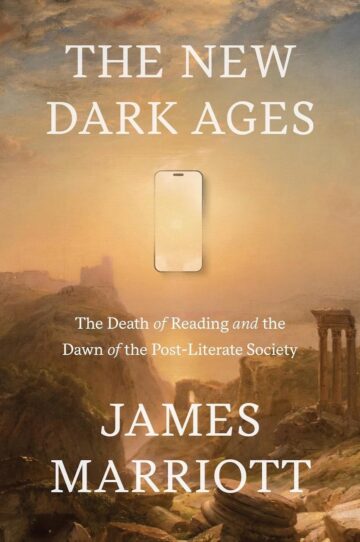
“[T]o discover the things that really enrich us we have to pay attention,” writes the British essayist James Marriott in The New Dark Ages: The Death of Reading and the Dawn of the Post-Literate Society (2026), the latest entrant in the literacy debate. “We have to patiently endure our initial sensations of bafflement and annoyance—why doesn’t this T. S. Eliot poem make any sense? Why are the Beatles making all these stupid noises with sitars?—until what seemed off-puttingly weird and wrong reveals itself to us as life-enrichingly true and profound.” Swiping affords constant, if superficial, gratification; reading takes a greater investment of time and energy but offers a bigger potential payoff. A funny TikTok or Instagram reel provides a moment of mindless diversion and a few laughs. Reading a novel by Tolstoy takes months and can change your life.
Marriott’s slender volume is well timed to restoke the fires of this debate just as it threatens to burn out. From the start, though, The New Dark Ages is too ominously titled. The need for a grabby name may be partly responsible for the growing exasperation of the literacy wars; a phrase like “the death of reading” in the subtitle likewise sets out to provoke and sell books but overstates Marriott’s position, which thoughtfully acknowledges limitations and engages with counterarguments. (His podcast for the BBC this spring had the more placid title “How Reading Made Us.”) Champions of the printed word risk alienating potential allies in the bookish cause when they exaggerate their case. As Crain put it in 2007, “There’s no reason to think that reading and writing are about to become extinct, but some sociologists speculate that reading books for pleasure will one day be the province of a special ‘reading class,’ much as it was before the arrival of mass literacy.”
As those comments from two decades ago suggest, the reading crisis is not new. Cathy Young recently pointed out in The Bulwark that books about the demise of literacy are perennial bestsellers, from Rudolf Flesch’s Why Johnny Can’t Read—And What You Can Do About It (1955) to Neil Postman’s Amusing Ourselves to Death: Public Discourse in the Age of Show Business (1985). I’m reminded of Michael Corleone’s remark about Hyman Roth: “He’s been dying of the same heart attack for 20 years.” This subgenre walks a fine line between moral panic and sociological corrective as it tickles a broader anxiety over the loss of a certain type of conservative priority. The written word is, after all, one of the oldest and most durable technologies of human civilization. Watching shiny innovations of dubious merit—television, smartphones, AI—threaten to supplant it with each new generation naturally alarms those who prize the tried and tested. Readers are like boxing fans cheering on a proud but aging champ who can’t keep fending off upstarts forever.
The key contribution of The New Dark Ages is to tie literacy to the Enlightenment. Marriott asserts that the written word’s receding influence has something to do with the steady disappearance of values like reason, scientific inquiry, political liberalism, and religious skepticism. These imperatives all arose alongside literacy during the reading revolution of the 18th century, as books on a variety of topics began to supplement scripture and devotional texts in the hands of ordinary citizens. This period in Western history marked the democratization of knowledge, which was no longer the exclusive province of churches and kings. Superstition and ignorance fell away, and an educated citizenry played a more active role in public life as peasants and laborers used books, newspapers, and pamphlets to arm themselves with facts and arguments.
As reading evolved from a niche pursuit for the wealthy and the lettered to a habit of the masses, it helped upend the ancien régime. “To Enlightenment philosophers like Diderot and Voltaire, Europe was shrouded in an ancient moth-eaten tapestry of morality, cliché and faith that they believed urgently needed to be unpicked,” Marriott writes. “They set about the task with enthusiasm.” This bracing iconoclasm led to revolutionary 18th-century ideas packaged in enduring books. Adam Smith’s The Wealth of Nations (1776) modernized the study of economics in the same way that Thomas Paine’s Rights of Man (1791) promoted representative democracy and political revolution over monarchy. Voltaire’s Treatise on Tolerance (1763) made a plea for an end to sectarian conflict, while Mary Wollstonecraft’s A Vindication of the Rights of Woman (1792) set out an early case for feminism. While the arguments in these books could be summarized verbally, they were far too complex to appear fully in any form other than print.
Marriott concedes that the association between reading and the Enlightenment is not simple or linear: “After all, many people have been killed in the name of grand and pre-eminently literate Enlightenment abstractions like ‘liberty, equality and fraternity.’ And of course a huge number of deranged, banal and evil books have been printed in the six hundred years since Gutenberg.” These are worthy cavils. Romanticizing past generations of readers is no way to make the case for print’s enduring worth, nor is gainsaying the violence, irrationality, and ideology that some books promote—think of hateful texts like The Protocols of the Elders of Zion (1903). Yet “eventually the critical and rational habits of thought associated with written communication did help to erode supernatural beliefs,” Marriott writes, and “if today witches are no longer burned and the principles of science are more generally accepted, then this is to a great degree down to the spread of print.”
Contrasting the written and oral traditions, Marriott argues that “complex and elaborate forms of knowledge like history, philosophy and science are not inevitable parts of human culture. Rather, they depend on literacy.” Text offers a greater opportunity for abstraction and nuance than other media. Yet as our attention spans and appetite for complexity have waned, media of all types have become simpler, particularly in recent years. In the book world, there are of course formulaic romantasy stories, hockey erotica, and young adult novels read by grown-ups. Today’s movie scripts frequently reiterate basic plot points that audiences in prior generations would have been trusted to infer for themselves. Marriott quotes a scene from the 2024 movie Irish Wish, in which Lindsay Lohan’s character helpfully sums up for the distracted viewer what has just taken place: “We spent a day together … I admit it was a beautiful day filled with dramatic vistas and romantic rain, but that doesn’t give you the right to question my life choices. Tomorrow I’m marrying Paul Kennedy!”
Speaking of Kennedys, the gradual turn away from written culture, with its possibilities for complexity and rigor, also erodes public life. Marriott contrasts the speaking styles of JFK and Donald Trump, separated by 60 years of steady devolution in American literacy. Kennedy’s political rhetoric was built on so-called “printed orality,” full of long sentences, detailed syntax, logical argument, and abstract principle. Trump, by contrast, speaks by piling up assertions, none of them organized analytically, and almost all favoring “the immediate, concrete world: bad people, border walls, drug lords.” This is not to say that Camelot—with its superficial glamour, tepid commitment to civil rights, and Cold War blunders—was a golden era of American history. But at least our leaders back then talked to us like adults. It is little wonder that Trump—who famously refuses to read anything at all—has led a movement against scientific research, equality among people, cooperation between nations, and the rule of law. His fans do not seem to spend their free time reading critical analyses of his disastrous policies. Instead, they watch as the president is valorized on Fox News.
Marriott ably diagnoses our reading woes, but his prognosis is less persuasive: “As reading fades, I believe that we may find ourselves facing a post-literate future that resembles the pre-literate past: mystical, tribal and autocratic.” In other words, he predicts regression rather than evolution. Comparing the recent vogue for vaccine skepticism with early fears about Edward Jenner’s smallpox vaccine in the late 18th century, Marriott also notes the similar rococo decorating habits of Trump and Louis XIV. Like yesterday’s monarchs, the leaders of tomorrow’s ignorant, unlettered citizenries will govern not through the wisdom of their policies but by the force of their personalities. This is “power as spectacle,” and it encompasses not just Trump but also figures such as the Salvadoran dictator Nayib Bukele, Russian president Vladimir Putin, and Romanian populist Călin Georgescu.
Enlightenment values like reason and science have certainly seen better days, and Marriott successfully links them to print culture. But his contention that we are headed for a new dark age elides a key distinction between the past and the present. Prior to mass literacy, most people lacked the ability to read. These days, reading is widespread as a basic skill, albeit one that has receded as a leisure activity. As critics of the reading-crisis thesis have pointed out, many people who do not read books in their free time are still perfectly capable of stringing written words together, and in fact spend their working days reading in various functional ways. Do we lose something as a society when we read emails and dry work documents instead of Jane Austen novels? Absolutely. Are we courting the same scenario as the Middle Ages, when a select few held the keys to knowledge, to the exclusion of all others? Probably not.
Nor can the reading crisis be blamed exclusively for the sorry state of affairs in 2026. Our present doldrums have many other causes too: income inequality, the influence of money in politics, the commodification of news as entertainment, deep-seated bigotry, the persistence of war. Not all of these concerns can be alleviated by more reading. One of the missteps of the anti-vaccine movement may be reading too much: crank screeds found down online rabbit holes have led its members astray. Trump’s garish decorating tastes are blessedly unique and do not seem to prefigure a broader return to the heavy drapes and gilded ornaments of Versailles. And to return to the OECD figures cited earlier: recall that two nations, Denmark and Finland, boasted growing literacy compared to their fellows in that study. Marriott’s association of declining literacy with political revanchism would suggest that those two countries are immune to the anti-immigration policies and racist illiberalism that have encroached elsewhere in recent years. Sadly, this is not so.
Yet the broad thrust of Marriott’s argument—there is a decline in reading that is antithetical to the progress of the Enlightenment—strikes me as persuasive and deeply troubling. The one area where the reading crisis, an associated mistrust of science, superficial public policy, and a dire future do unquestionably converge is a crucible I have not seen discussed in The New Dark Ages or elsewhere in the literacy debate. It is, of course, climate change. Whether we stop vaccinating against the measles long enough for cases to rise, and for fools to realize their mistake, is bad enough. But a refusal to acknowledge demonstrated scientific facts that will irreversibly spell doom for the planet raises the stakes considerably. I would tell you to find a climate skeptic you know, hand them a book like Spencer R. Weart’s The Discovery of Global Warming (2003), and urge them to educate themselves. But they probably wouldn’t read it.