The men’s final between Jannik Sinner and Alexander Zverev at Wimbledon last month resembled a shootout from the 1990s. Back then, tennis stars such as Pete Sampras and Goran Ivanišević routinely hit dominant serves and played short points, offering little variety or intrigue for fans. Messrs. Sinner and Zverev made around 70% of their first serves and engaged in few long rallies. Before Mr. Sinner claimed the title in four sets, a friend texted to say, “good lord this is boring tennis.”
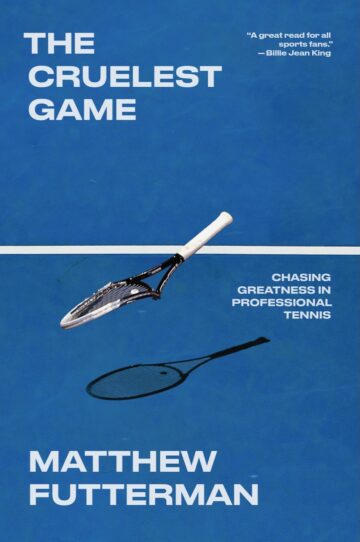
Tennis is a sport of eras, as Matthew Futterman emphasizes in The Cruelest Game, a snapshot of modern tennis and its leading personalities. The Sinner-Zverev match was thankfully an aberration. The sport today offers much on-court variety and frequently produces exciting matches. A dogged battle between Chris Evert and Martina Navratilova from the late 1970s—wooden rackets and all—is almost unrecognizable next to today’s high-intensity pace and graphite tools. When Björn Borg tried to return to tennis in 1991 after eight years in retirement, he played nine matches without winning a set. The game had passed him by. This year, the once-dominant Serena Williams was similarly humbled after four years away, losing in the first round at Wimbledon.
Mr. Futterman, a journalist at The Athletic, captures how tennis has moved on from a golden age of champions such as Ms. Williams, Justine Henin, Roger Federer and Rafael Nadal to welcome new greats such as Mr. Sinner, Carlos Alcaraz, Coco Gauff and Aryna Sabalenka. The book offers capsule biographies of the game’s young stars. Naomi Osaka, the author writes, “ticks all the boxes. She’s exceptionally curious, constantly asking questions, not simply following commands” as she tries to rebuild her game following the birth of her daughter. Mr. Sinner is the “cool northern Italian redhead with the Germanic roots and the most punishing of ground strokes.” His rivalry with Mr. Alcaraz has given fans some of the more memorable recent battles in men’s tennis.
Yet the old lions refuse to surrender to the cubs. Mr. Futterman portrays this generational struggle as both brutal and inevitable. As he writes of Novak Djokovic, who has won 24 Grand Slams, “how could anyone who experiences that not want to experience it again and again and again, for as long as they possibly can, no matter what it takes?” Mr. Djokovic is one of the book’s more revealing subjects. The author describes the Serbian as “the most curious, hungry, ever-seeking athlete on the planet.” Mr. Djokovic—who is polarizing and was never as beloved as his rivals Messrs. Federer and Nadal—is both a rare physical specimen and a brilliant tactician. He tells Mr. Futterman that he cuts through the pressure by focusing on sensations such as how the ball feels coming off the strings of his racket and the cool press of the ice towel between games. His mindfulness allows him to play with a freedom that younger players seek but seldom achieve.
Tennis is the cruelest game for a variety of reasons, Mr. Futterman contends. It is both lonely and silent, with the players on their own as they compete, unless they have an overbearing coach yelling at them from the sidelines. The unusual scoring system attacks the ego, with champions losing almost as many points as they win. No other sport, Mr. Futterman writes, has as many stars, such as Jennifer Capriati, Mats Wilander and Kim Clijsters, who unravel or quit in their prime. Its margins are almost metaphysical; tennis “is all about time—gathering it for yourself, taking it away from the opponent, battling against its relentless move toward the end of a brief career.”
Mr. Futterman occasionally exaggerates his case with over-the-top prose. Tennis “appears uniquely designed to double as an MRI of the soul,” he asserts. “You can do this sport, but it might kill you”—spiritually if not literally. It is certainly true that tennis requires discipline and sacrifice, but is this country-club sport really more intense than, say, distance running, mountaineering or solo sailing? Mr. Sinner offers refreshing perspective. Win or lose, he remains humble and loves spending time with his family. “The most important thing,” he placidly tells the author, “is that we are healthy, that we are having a nice time together.”
The Cruelest Game overlooks some of the most interesting trend lines in tennis today. Despite equal prize money for men and women at the four Grand Slams, pay disparity persists at many other tournaments globally. Mr. Futterman’s focus on superstars will leave some readers wishing he’d chronicled the occasional journeyman, like Dan Evans or Diane Parry, trying to scrape out wins and paychecks. And he doesn’t consider how the best-of-five-set format in men’s tennis looks increasingly tenuous as matches run longer and cause frequent injuries. Mr. Djokovic and Félix Auger-Aliassime recently played the longest quarterfinal in Wimbledon history, at 5 hours, 15 minutes.
Mr. Futterman, the author of Players: How Sports Became a Business (2016), notes how canny investors stake players from a young age. Alfonso López Rueda, a Spanish dessert mogul, began supporting Mr. Alcaraz when he was around 10 years old. The author also has a keen eye—and little patience—for preening coaches. Mr. Sinner’s ex-coach Riccardo Piatti, who runs his own tennis academy on the Italian Riviera and frequently appears on television as a commentator, comes off as a one-man conglomerate. Of the beautifully coiffed Patrick Mouratoglou, who coached Ms. Williams, the author writes, “don’t step between him and a television camera.”
The Cruelest Game is a solid companion as the U.S. Open approaches. Will Mr. Alcaraz return diminished from the wrist injury that has kept him from competing in the two most recent Grand Slams? How long can the fascinating variety at the top of the women’s tour persist? Might a fading champion like Ms. Williams reclaim her former renown in a few weeks? Tennis is a sport that rewards our keenest attention. It feels impossible not to watch and find out.