In 1977, Martin Scorsese was working in a cocaine-filled, insomniac frenzy to complete The Last Waltz, his film about The Band’s final concert. One evening, he and his housemate, the group’s guitarist, Robbie Robertson, invited friends to watch a rough cut. Francis Ford Coppola, one of the guests, disliked what he saw—not about the film but about what the boys were eating. Coppola decided to cook dinner, giving Robertson precise instructions to prevent the marinara sauce from sticking as it simmered. The rocker left to see a dealer, and the sauce burned; Scorsese told everyone to praise the food anyway. Before leaving, Coppola gave a stern lecture about eating better. One onlooker summarized the tenor of the remarks: “This is like your father talking. ‘You’d better shape up with the food.’”
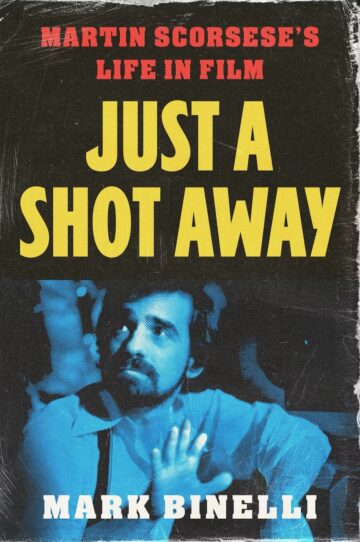
Journalist Mark Binelli reproduces this set piece in Just a Shot Away: Martin Scorsese’s Life in Film, which is presented as the first major biography of the prodigious director. Movie buffs will recognize the encounter from a famous scene in Scorsese’s masterpiece Goodfellas (1990), in which a similar stir-the-sauce directive plays out against a riot of helicopters and drugs. The echo is telling: Scorsese was able to capture the frantic paranoia of Goodfellas because he had lived it. After unspooling his life story, Binelli found that Scorsese’s movies began “to feel like smuggled chapters of an autobiography.”
Just a Shot Away is a detailed, funny, and insightful biography worthy of its subject’s mighty stature, although it neglects the back half of his life. Now in his 80s, Scorsese remains remarkably busy even as he shifts into valedictory mode. He has at last been feted with the Oscar for best director (for 2006’s The Departed ) that the Academy long denied him and appeared as a sort of metafictional grandfather of cinema in 2023’s Killers of the Flower Moon. Last year, he was the subject of Rebecca Miller’s excellent five-part documentary Mr. Scorsese. These milestones deal in iconography, reinforcing our image of the bushy-browed, fast-talking cineaste who may be film’s greatest booster. Yet Binelli writes that the man behind the persona has proved elusive and warrants unpacking.
Scorsese grew up in Manhattan’s Little Italy, where outsize characters and Old World customs shaped his outlook. A black-bordered letter from home meant a death in the family; drinking plain, cold water supposedly eliminated the need for doctors. Scorsese’s first-generation parents drilled into him the need to be careful about the Mafia figures he saw every day: Don’t use names; see nothing and say nothing. With characters like Jimmy Balls and Paulie Lefty roaming the streets, it paid to be wary. Observation came naturally to Scorsese, a diminutive asthmatic who nevertheless dressed like the big shots and absorbed their patter. A brief stint in the seminary ended when he grew into his hormones.
Binelli follows Scorsese through film school at NYU and then into early projects, including a short-lived assistant director position for the 1970 concert movie Woodstock. He got fired. “You could picture the fusillade of movie references, musical opinions, and passionately argued editorial choices, delivered at the speed of Marty at Sicilian-supper-table volume to his stoned colleagues,” Binelli writes. The experience prefigured Scorsese’s uncanny ability to edit film to rock music and helped him hone his craft. Marginal notes that he wrote in another director’s script in the late ’60s were full of brisk confidence. “Maybe start on Fat Man’s stomach fast zoom out and up to his face as he turns quickly to stare at camera,” went one.
After breaking through in Mean Streets (1973), Scorsese went on to win critical acclaim and success with Taxi Driver (1976) and Raging Bull (1980)—a gritty trio built on a remarkable partnership with the young actor Robert De Niro. Other pictures flopped, like New York, New York(1977) and The King of Comedy (1982). During these years, Scorsese consumed heroic amounts of cocaine, quaaludes, speed, and other drugs, as screenwriter Mardik Martin’s previously untapped recordings and transcripts from those years show. A snapshot of the artist at work, these materials display Scorsese conceiving, in real time, scenes with blocking, camera moves, and narrative beats fully formed, demonstrating an extraordinary cinematic facility.
He hit rock bottom and nearly died from drugs and exhaustion in 1978. Binelli complicates the linear redemption narrative presented in Mr. Scorsese that has De Niro delivering harsh wisdom and offering Raging Bull as a fresh path forward. In truth, Scorsese’s addictions and anxiety persisted for years. He continued to alternate studio hits such as The Color of Money (1986) with daring flops like The Last Temptation of Christ (1988), remaining an underdog and something of a Hollywood outsider.
All led up to Goodfellas, a film of huge audacity and technical brio, from its camerawork to its editing, narrative structure, and production design. It moves at the speed of sound: Needle drops come thick and fast, featuring Tony Bennett, the Rolling Stones, the Who, Muddy Waters, and many others. The gangsters depicted in the movie lived in the world where Scorsese grew up; he glamorized their lifestyle and then horrifyingly upended it as the party decisively stopped. Goodfellas, Binelli writes, “synthesized everything he’d done before into a style he’d revisit, refine, and intensify in the years to come.”
Yet there the book ends, suddenly and disappointingly. Just a Shot Away covers the first half of Scorsese’s life and work but crams a huge and worthy filmography—Casino, The Wolf of Wall Street, Silence, and many others—not to mention decades of living into a nine-page epilogue. This is a mistake. Just a Shot Away should be the first of a two-volume project, with Binelli well positioned to undertake the back half. There is plenty to choose from in the Rolling Stones catalog for the follow-up title. Sadly, for the reader, it may be “You Can’t Always Get What You Want.”