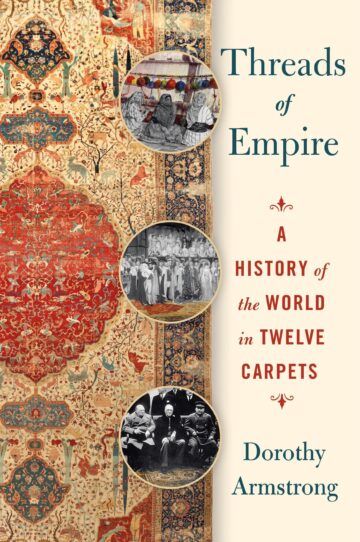
A famous photograph captures Churchill, Roosevelt and Stalin during the 1945 Yalta Conference. They look cold in their greatcoats, and Stalin alone wears military dress. A handful of luxurious carpets warm the ground and provide an air of Black Sea luxury suitable to the occasion. The largest rug, figured with floral motifs, projects opulence and taste. For the textile scholar Dorothy Armstrong, its designs reveal something deeper. The rug, she observes, lacks the patterns of traditional carpet making from Tatar artisans who would have been native to the Crimean Peninsula where the resort was located. “In the summer of 1944,” she reminds us, “Stalin had purged the Crimea of its Tatars.” The rug used was an import from elsewhere.
“The world beneath our feet tends to be less observed than the world at eye level,” writes Ms. Armstrong. “Once we begin to look, we can see carpets in every environment which celebrates power.” In “Threads of Empire,” she takes readers on a beguiling tour of the past, one in which carpets become talismans of culture, aspiration, deceit and imperialism. The book displays deep learning, endless curiosity—and a conviction that seemingly mute objects can be anything but. “Even when they are appropriated as props by the great and powerful,” she writes, “carpets find ways to tell their individual stories, which sometimes subvert and always complicate received histories.”
Take the Ardabil, widely regarded as the finest example of the Persian carpet-making tradition and today housed in London’s Victoria and Albert Museum. At 33 feet by 17 it is a gigantic specimen of hand-woven artistry. The nearly 500-year-old Ardabil, Ms. Armstrong writes, embodies “a refined Persia of intellectual clarity and unmatched visual inventiveness.” Yet the carpet’s uniqueness and outstanding state of preservation both waver upon inspection. The Ardabil was originally one of a matched pair, but the other carpet had at some point been mutilated to restore the damaged edges of its sibling. Long-held assumptions that men must have woven the masterpiece likewise fail. As Ms. Armstrong explains, most of the world’s weavers are women. The Ardabil also distills the orientalist viewpoint that made a patronizing fetish of an eastern culture. With their “Indo-European language and their ‘European’ physical attributes,” Aryan Persians were thought to be “the first cousins of the world’s natural leaders.”
A theme running through “Threads of Empire” is the difficulty of dating rugs and ascertaining where they were made. The Ardabil bears an inscription and year on one edge, as well as a notation of the court that the weaver served. “To have this amount of information woven into a carpet is vanishingly rare,” Ms. Armstrong writes. Carbon dating is expensive and cannot determine geography; chemical analysis of dyes has its own limitations. Instead, carpet experts usually place textiles through visual inspection, examining a rug’s patterns and motifs, as well as its knotting and weave.
The cleverest trick is to spot rugs that feature in paintings of the European Renaissance; artists dazzled prospective clients by rendering the colors and luster of woven carpets, and the portraitist Hans Holbein had a rug collection of his own. Lorenzo Lotto’s painting “The Alms of St Antoninus” (1542) uses a prominently displayed Anatolian carpet to underscore, Ms. Armstrong suggests, the wealth and might of the Catholic church. Yet even when such art-historical sleuthing yields a match, as Ms. Armstrong explains, “the basic questions of when, why, where and by whom carpets were made often go unanswered.” This ambiguity contributes to the mystique of fine rugs, which can be centuries old, to and heightens their appeal those who love them as objects in their own right.
Where Ms. Armstrong analyzes with the mind of a scholar, the poet George Bradley collects with the heart of an aesthete. He has written a winning memoir of his seduction by beautiful rugs. “Carpet Diem” is a worthy counterpoint to “Threads of Empire,” showing that, whatever they teach about history, carpets are first and foremost enduring objects of handcrafted beauty. If Ms. Armstrong sees a rug’s provenance as a key to the past, to Mr. Bradley it is a mark of discernment among collectors. “Connoisseurs quibble, particularly when there’s no way to win the argument, which is often the case where a rug’s date is concerned.”
Mr. Bradley is a writer with a range of interests in antiquities and artisanal products, including wine, Byzantine art and olive oil. He traces his love of carpets to a 4-by-7-foot throw rug that he inherited from his great-grandfather, who had been the U.S. consul in Jerusalem during World War I. After toting the rug to this and that home over the years, Mr. Bradley finally took the time to examine it closely and became captivated by its arabesques and vines, blossoms and medallions. Above all, he admired its rich and enduring colors. “Color is to an antique rug what bouquet is to a vintage wine,” he writes.
The experience ignited a passion for collecting rugs. On scouting trips throughout New England, Mr. Bradley learned to negotiate, and found that the bargaining customary in the rug business began creeping into other aspects of his life. At one point he caught himself trying to haggle a 2-for-1 funeral deal as he buried one of his parents. He also came by several hard lessons: His account of one long-running dispute finds him attempting to collect payment for a valuable rug made in Dagestan that he sold to a slippery dealer who kept promising to settle up later. It is a tale of bounced checks, unreturned phone calls and the rug’s unexpected detour to Turkey for repairs. Eventually, Mr. Bradley agreed to a trade, swapping an “exceptional carpet for two average ones,” and losing some of his innocence in the process.
“Carpet Diem” is at its best when reproducing lovely color plates of the rugs under discussion—and when describing their enchantments. One of the most satisfying acquisitions of Mr. Bradley’s career was a Tabriz rug from 19th-century Iran. His loving description of the piece speaks to the depth of his appreciation. “The complex interplay of elements is perfectly balanced, and the borders articulate precisely at the corners,” Mr. Bradley writes. “It’s sophisticated in conception, harmonious in palette, and meticulously woven, a consummate example of the kind of artifice that is cool and cerebral.” Alas, it is too delicate to walk on, and it can’t be hung on the wall because “its own weight might tear it apart.” So he tucks it away and brings it out only occasionally to admire or show to others.
This pair of books ultimately prompts the reader to look beyond sleek screens and the soothingly uncanny whisper of AI to celebrate an ancient craft. Like maps, globes, wristwatches and books, fine carpets endure because dedicated craftsmanship has a value all its own. Sometimes the old ways are best.