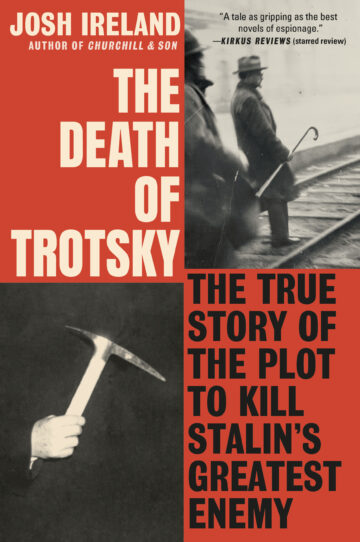
It is one of the most notorious murders of the 20th century. In 1940 a Soviet spy killed the exiled revolutionary Leon Trotsky in his home in Mexico City, acting on orders from Joseph Stalin. The shocking crime reduced grand ideas about Marxism and the nobility of the proletariat to an act of cold vengeance, showing that no one was safe from the dictator’s wrath. This story has been told and retold in histories and the biographies of both men, its familiar beats taking on iconic status, from Trotsky’s place as Stalin’s “enemy number one” to the grisly murder weapon (an ice ax). Is it possible to recount what happened with fresh urgency?
For Josh Ireland, the author of The Traitors (2017) and Churchill & Son (2021), the answer is to write a spy thriller. Mr. Ireland’s The Death of Trotsky is an exciting and propulsive nonfiction account that reads like an Alan Furst novel. And well it might, for the killing was, after all, the culmination of a major intelligence operation that lasted years, spanned the globe and relied on countless moving parts. The best espionage stories come to life in the details, from the lives of the agents to the weather in far-flung cities. Mr. Ireland has a particular talent for this sort of granular storytelling. He points out, for example, that Stalin loved maps and kept one on his wall that “was so big that to reach a region like Kolyma in the distant east, he would have to take several paces.”
In the troika of major figures in the Russian Revolution, Trotsky stood for ideas and Stalin represented power; their predecessor, Vladimir Lenin, had fused the two values as the frowning avatar of communist leadership. When Lenin died in 1924, the two rivals clashed for the right to take his place. (That Lenin was unable to tip the scales was a near-run thing; he had been planning to denounce Stalin when felled by a stroke.) Mr. Ireland sketches the antagonists with vivid details. Stalin “possessed both an uncontrollable temper and extraordinary willpower. He was capable of bewildering recklessness and cold-blooded displays of control.” Trotsky was a dazzling speaker and a dandy who “never quite stopped being a clever schoolboy desperate to show others how much he had learned.” The two men hated each other.
After Stalin won the power struggle, he exiled Trotsky from Moscow in 1928 and from the Soviet Union the following year. His nemesis was more than a rival—he was a symbol. To be a Trotskyite was to hold the wrong ideas about communism; it was a ready proxy for being an intellectual, a spy, a Jew and ultimately an enemy of the state. Trotsky fled to Turkey, then France and Norway, finding long-term refuge in Mexico, whose government offered asylum and whose leading artist, Diego Rivera, provided comradery. Some of Mr. Ireland’s best pages are about the ways the freewheeling Rivera broke Trotsky from his rigid writing schedule, getting him out of his study and onto the back of a horse. The friendship could not survive Trotsky’s affair with Rivera’s wife, the painter Frida Kahlo. The revolutionary and his entourage moved out of the artists’ orbit and into a “gloomy-looking mansion,” which they fortified against attack.
A good idea, because Trotsky had been sentenced to death in 1936, at the outset of the Great Terror. Stalin wanted him eliminated. The agent ultimately tasked with carrying out his assassination was Ramón Mercader, a Spanish communist who “knew a little about a lot and had a great memory.” He was “perceptive, meticulous, and scrupulous,” Mr. Ireland writes, and came by his revolutionary bona fides honestly. His mother, Caridad Mercader, was a Cuban-born militant; on the fateful day, she sat waiting for her son in the getaway car. The pair were the original Neiman Marxists, the son peacocking in handsome leggings over café au lait trousers; the mother a cosmopolitan who loved shopping on Fifth Avenue in New York and hated the drab gray of Moscow.
In a series of maneuvers fit for a John le Carré story, Mercader slowly ingratiated himself into the Trotsky household. An agent for the NKVD, the Soviet Union’s secret police, arranged an introduction between Mercader and Sylvia Ageloff, a left-wing social worker from Brooklyn, N.Y., whose sister had once been Trotsky’s secretary. Mercader seduced Ageloff, who would become an unwitting pawn in the murder of one of her heroes. He lured her to Mexico City and became known as her boyfriend around the Trotsky house. As he worked his way in closer, Mercader reported to Leonid Eitignon, a Soviet spymaster who “always appeared to be in control. A glass of cognac would last him an entire evening.”
Mr. Ireland draws the reader’s sympathy toward Trotsky, to a point, as an old man out of the game who did not deserve to be killed. He maintained a strong and tender marriage, despite his fling with Kahlo, and tried to keep up with the times during breaks from work on his biography of Stalin. Delighted to receive a dictionary of slang as a gift, he explored its application to his own interests. “In the part I have already studied, which is devoted to college slang,” Trotsky wrote in a letter, “I had hoped to find some abbreviations for the various sciences, philosophical theories, etc., but instead I found merely about 25 expressions for an attractive girl. Nothing at all about dialectics or materialism.” Mr. Ireland also shows the anguish Trotsky suffered at the mistreatment of his family members left behind, many of whom were exiled or shot.
Trotsky’s fate may be well known, yet the final chapters of Mr. Ireland’s book should no more be spoiled than should a gripping page turner. This type of historical storytelling does have its limitations. The author relies not on original research but on other accounts, including books by Isaac Don Levine, Robert Service and Dmitri Volkogonov. And he does not apply those historians’ rigor on every page. He glosses over, for example, the complex details of Mercader’s trial, skipping straight to his 20-year prison sentence. Despite these shortcomings, The Death of Trotsky is a tremendously readable book with a haunting message: Vengeance never sleeps.