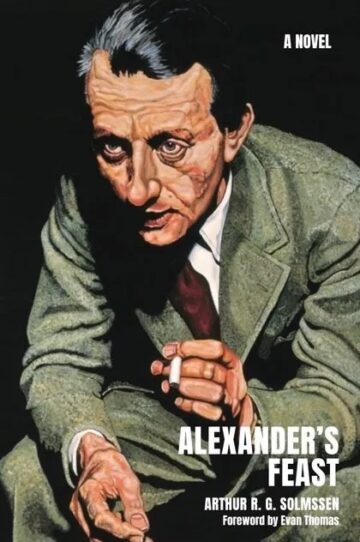
When did the Cold War begin? In the pages of Arthur R.G. Solmssen’s 1971 novel, Alexander’s Feast, a young American witnesses one sign of its opening in an idyllic European setting. Graham Anders, an inexperienced soldier, is stationed in Salzburg, Austria, where he takes part in the 1947 creation of an institution called the American Academy in Europe—a roundtable meant to advance the understanding of democracy and to recruit students from a variety of countries. Fourteen years later, Graham returns to Salzburg as an attorney, after the program has matured, to discover something has soured. An idealistic forum for postwar rebuilding, he discovers, has become a front for espionage and cynical realpolitik.
Alexander’s Feast is the most worldly in a quartet of novels by Solmssen (1928-2018) that have been recently republished by Tivoli. Solmssen practiced law and maintained a second career as a writer, publishing five novels as well as nonfiction work. “I don’t play golf, tennis or squash,” he once said in an interview, explaining his productivity, “and I don’t play bridge or mow the lawn.” Solmssen did attend the Salzburg Seminar—the real-world model for his novel’s American Academy.
Three of Solmssen’s resurrected books—Rittenhouse Square (1968), The Comfort Letter (1975) and Takeover Time (1986)—explore the manners and morals of Philadelphia’s upper crust. Alexander’s Feast takes on questions about the cost of spreading democracy in the mid-20th century. The novel introduces Graham in the early 1960s, as a successful, if morally directionless, Philadelphia lawyer. An old friend asks him to travel to Salzburg to lend his legal expertise to the very same academy he saw founded years before.
This unexpected request prompts a flashback to Graham’s military posting in postwar Austria, which comprises the heart of the novel. As a soldier assigned to help in the American Academy’s early days, Graham is there for its first session and hears the chairman ask his guests to put aside their wartime differences. “I think that for many of you this will be the first opportunity for extended friendly intercourse with educated people from other countries,” he says, suggesting that they may “find that they can after all communicate with men they thought they hated.” Participants debate how dire a threat the Soviet empire will prove to be, anticipating the ideological battles of the 1950s.
Yet the noble aims of the academy begin to look like idealistic naiveté when a group of Dutch law students—who have lost much in the war—bristle at the mixed company. As one of their number says, “we came down here to learn about the United States, to read about Thomas Jefferson, about Mark Twain. We did not come down here to drink beer with German officers!” Graham finds his own principles tested when he begins a love affair with the Austrian countess whose estate is hosting the academy; her late husband, he learns, fought for the Germans. Graham also pits his own ethics against postwar bureaucracy (and the orders of his superiors) by assisting a group of Jewish refugees who are attempting to reach Palestine. After less than a year in Salzburg, he’s discharged and sent home, back on the path to a conventional legal career.
By the time Graham returns to the Austrian city, in 1961, he is a participant rather than an observer. He learns that members of the Swedish and American delegations are not primarily academics. They are spies. The academy has become a way station for intelligence agents. Graham believes their activities will ruin the program and disgrace the memory of its founders. Solmssen sets up a final-act showdown in which Graham must decide how far he should go to reveal the truth of what the academy has become.
Graham’s high-minded simplicity as he confronts this dilemma is among the novel’s weaker points. The older Graham is portrayed as a sophisticated attorney, steeped in complex legal and business affairs. Yet he confronts the nuanced situation in Europe in facile terms, seemingly unable to perceive shades of gray. Alexander’s Feast is also weighed down by its lengthy opening section, which centers on Graham’s life in Philadelphia and the minor intrigues of his legal career. The book can feel overstuffed, variously reproducing correspondence, memos, dreams, trial transcripts and even a snatch of sheet music.
Despite these limitations, “Alexander’s Feast” is an engaging intellectual thriller. Solmssen dots his story with signposts that will keep students of history engaged as they turn pages. His character Boswell Hyde—a “self-possessed pear-shaped young man in his rumpled seersuckers and his jaunty bow tie”—bears a close resemblance to Arthur M. Schlesinger Jr., the Harvard professor and adviser to John F. Kennedy. The Berlin airlift features briefly, as does George Kennan’s “X” article from Foreign Affairs magazine in 1947, which introduced the concept of containment. The story ends shortly after the Berlin Wall begins to go up in the summer of 1961.
Along the way the reader follows Graham as the academy’s intrigue threatens to consume him, to the detriment of his legal practice and his marriage. There is much to recommend in Alexander’s Feast, as well as the broader reissue of Solmssen’s fiction. He has a fine touch for telling details. Boswell is a “pudgy intelligent owl,” while the countess “shook hands firmly, like a queen.” His characters let us feel the chill in Europe as the Iron Curtain descended.